
Origins and traditions of African vetiver: the fascinating history of gongolili khamaré
Sommaire de l'article

Behind every bunch of khamaré vetiver roots lies a story spanning centuries. A story that crosses continents, cultures, and generations. To understand why this plant holds such a special place in African traditions, we must go back to its origins, both literally and figuratively.
This article takes you on a journey to discover khamaré vetiver in its cultural and historical dimension. A voyage into the heart of West Africa’s ancestral knowledge.
Before diving into the story, discover our khamaré vetiver root selected according to these same traditions.
The origins of vetiver: a plant that travels
Contrary to what one might imagine, vetiver (Chrysopogon zizanioides) is not native to Africa. Its region of origin is India, more precisely in the plains of the Indian subcontinent. It was there that the plant was first cultivated, valued for its fragrant roots used in artisanal perfumery and body care.
It is through trade routes, human migrations, and colonial expansion that vetiver gradually made its way to West Africa. Upon arriving on this continent, it was adopted, adapted, and reinterpreted according to local cultures, until it became a pillar of wellness traditions.
Khamaré vetiver in West Africa: deep cultural roots
Senegal and Gambia: the cradle of khamaré
It is in the Senegambian region that the term “khamaré” emerged and took on its full meaning. In Senegalese societies, khamaré vetiver is inseparable from women’s care practices. Wolof, Mandingue, and Sérère women used vetiver roots in their ritual baths, particularly for preparations linked to major life transitions: marriages, childbirth, initiation ceremonies.

Ourkhamaré vetiveris selected according to these same traditional criteria.
Khamaré was not just a simple wellness product; it carried strong social and cultural symbolism. Giving khamaré to a woman was offering her precious care, a gesture of consideration and goodwill.
Mali and Burkina Faso: gongolili in Sahelian traditions
Further east, in Sahelian countries like Mali, Burkina Faso, and Côte d’Ivoire, vetiver is known as gongolili. Uses are similar but enriched with local variations. Notably, gongolili is used in gentle fumigations, created by lightly burning the roots on embers to perfume clothes and living spaces.
In some communities, gongolili also played a role in purification rituals for spaces after difficult events. The fragrant smoke from vetiver roots was considered purifying and soothing.

Aïssa’s selection

Organic khamaré vetiver roots (Gongolili)
+6,500 customers · Rating 4.97/5 ★★★★★
From €12.90
Discover the product →Traditional knowledge around African vetiver
Oral transmission of practices
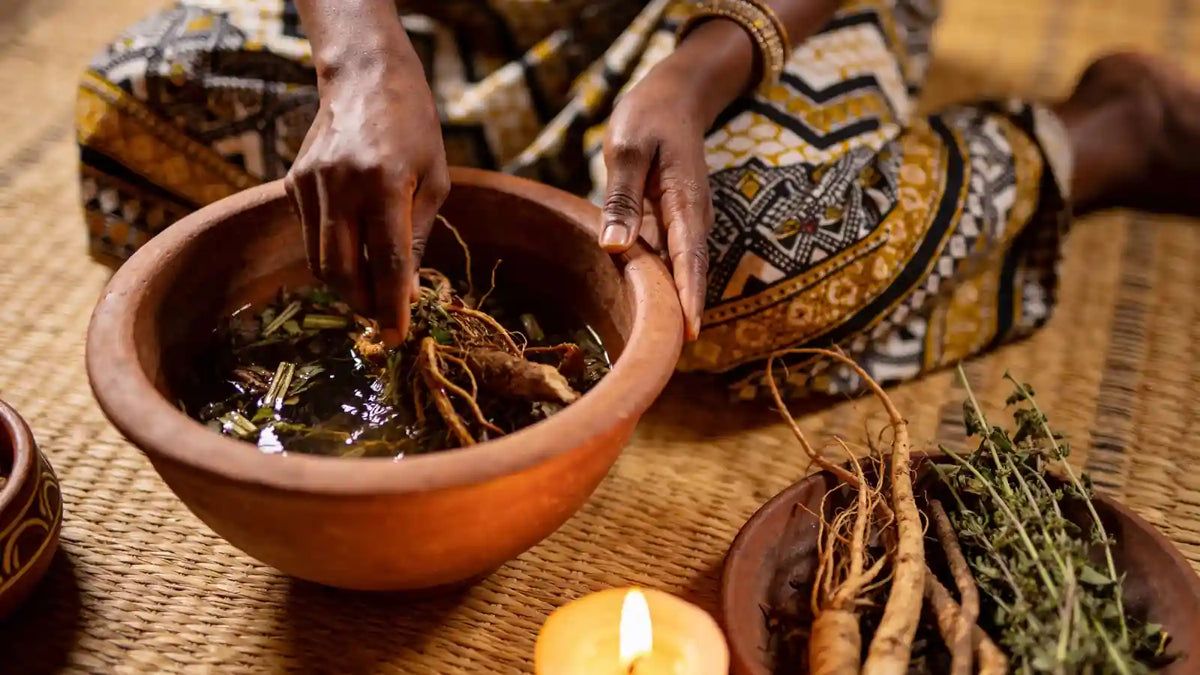
Like most knowledge in West Africa, knowledge of khamaré vetiver has been passed down orally, from mother to daughter, grandmother to granddaughter. These transmissions were not only through words, but also through gestures: the way to break the roots, the ideal infusion time, the amount to use depending on the occasion.
It is this wealth of know-how that makes khamaré vetiver irreplaceable. Each family had their own variations, their own recipes passed down with care.
Vetiver in African wellness preparations
Over centuries, khamaré vetiver has been integrated into many traditional African preparations:
-
Thiouraye: fragrant mixtures burned on embers, made with vetiver, resins, and other aromatic plants
-
Steam baths: vetiver water used for steam beauty care, very common in Senegal
-
Fragrant sachets: vetiver roots placed in clothes and wardrobes
-
Postpartum care: used in young mothers’ baths after childbirth
All these preparations start with choosing goodquality khamaré vetiver.
These practices are not mere superstitions; they reflect deep knowledge of the plant’s aromatic and sensory properties.
Khamaré vetiver and African perfumery
West Africa has an extremely rich perfume culture, often unknown outside the continent. Khamaré vetiver is one of its pillars. Before the arrival of industrial synthetic perfumes, African families created their own fragrant compositions using local roots, resins, woods, and aromatic plants.
Vetiver, with its woody, earthy, slightly smoky scent profile, played the role of base note in these compositions. It “anchored” other fragrances, making them more long-lasting and deep. This natural fixative role is why it remains highly sought after in contemporary artisanal perfumery today.

From Africa to the world: the renaissance of khamaré vetiver
Long limited to domestic and family uses, African vetiver roots are experiencing a true renaissance today. The African diaspora in Europe and the United States has played a key role in this revival, bringing its wellness traditions into new cultural contexts.
At the same time, the back-to-nature and plant movement has put khamaré vetiver in the spotlight for a wider audience. People with no direct connection to West Africa are discovering these roots and adopting them for their personal rituals.
This growing popularity is good news, as long as it is accompanied by fair recognition of African traditions and production chains.
FAQ - Origin and traditions of African vetiver
1. Is khamaré vetiver really native to Africa?
Botanically, vetiver comes from India. But khamaré, as a cultural practice and know-how, is fully African. It was West Africa that developed its own uses, methods, and relationship with this plant.
2. Why is khamaré vetiver called gongolili in some countries?
Both terms refer to the same plant, but in different cultural and linguistic contexts. Khamaré is used mainly in the Senegambian zone, while gongolili is the common term in Mandé Sahelian countries. These variants reflect the linguistic diversity of West Africa.
3. Is khamaré vetiver still used traditionally in Africa?
Yes, absolutely. Khamaré vetiver traditions remain very much alive, particularly in Senegal, Gambia, Mali, and Burkina Faso. These uses coexist with modern practices and are still passed down within families.
4. Has khamaré vetiver been influenced by other cultures?
Trade exchanges with India, the Middle East, and later Europe have certainly influenced some practices. But the heart of African vetiver traditions remains deeply endogenous, developed from local knowledge accumulated over centuries.
Conclusion: preserving a living heritage
Khamaré vetiver is not just an exotic product. It is the bearer of a living, fragile, and precious cultural heritage. By choosing to integrate it into your daily life, you contribute to the recognition and transmission of these African ancestral knowledges.
That is why we select ourkhamaré vetiverwith the greatest care, respecting these African production chains.

Each bunch of roots tells a story: of the women who learned to use them, the markets where they were sold, the generations that passed down this natural treasure.

À lire aussi

The incredible benefits of organic moringa leaf infusion
Organic moringa leaf infusion: traditional benefits, preparation, and secrets If you are looking for a natural drink to...
Lire l'article
Khamaré Vetiver Well-Being Ritual: How to Turn Your Routine Into a Sensory Experience
There are plants that heal. There are plants that nourish. And then there is the vetiver khamaré, a plant...
Lire l'article
How to use khamaré vetiver roots: complete tutorial, origin and tips
Did you just purchase a bouquet of khamaré vetiver roots and aren’t sure where to start? You’ve heard...
Lire l'article
Leave a comment