
How to choose quality djeka leaves: the savvy buyer’s guide
Sommaire de l'article
How to choose high-quality djeka leaves? Everything you need to check before buying
The market of djeka leaves has exploded in popularity in recent years. What was once only available at African markets or specialty grocery stores is now offered on dozens of online shops. And as is often the case when a product gains widespread popularity, quality varies significantly from one seller to the next.
Result: some customers receive dull, unscented, poorly dried leaves of questionable origin, and don't understand why the experience doesn't live up to what they'd heard. This guide is here to help you avoid this disappointment.
Criterion 1: Organic origin
This is the first indicator of trustworthiness to verify. Organic djeka leaves are cultivated without pesticides, chemical fertilizers, or synthetic herbicides.
Why is this important? Because djeka leaves are used in infusions (so they are ingested) and in decoctions for intimate hygiene (so they come into direct contact with delicate mucous membranes). Under these circumstances, product purity is non-negotiable.
Our organic djeka leaves are organic, guaranteeing a rigorously controlled product, from cultivation all the way to sachet packaging.
Criterion 2: Geographic origin
Not all origins are equal. The best djeka leaves come from traditional cultivation regions: Senegal, Côte d'Ivoire, Ghana, Benin. These countries have ideal climatic and soil conditions to produce an aromatically rich plant.
A reputable seller will be able to tell you the exact country of origin of the product. If the product listing remains vague on this point (only listing "West Africa" without further details, or no mention of origin at all), this is a red flag.
Our sheets come from the Senegal, grown under optimal natural conditions. The origin is clearly stated and is part of our traceability commitment.
Criterion 3: Drying quality
Drying is a crucial step for the final quality of the leaves. Improper drying, whether too fast, too moist, or performed at unsuitable temperatures, will degrade the plant's aromatic compounds and significantly reduce the quality of your preparations.
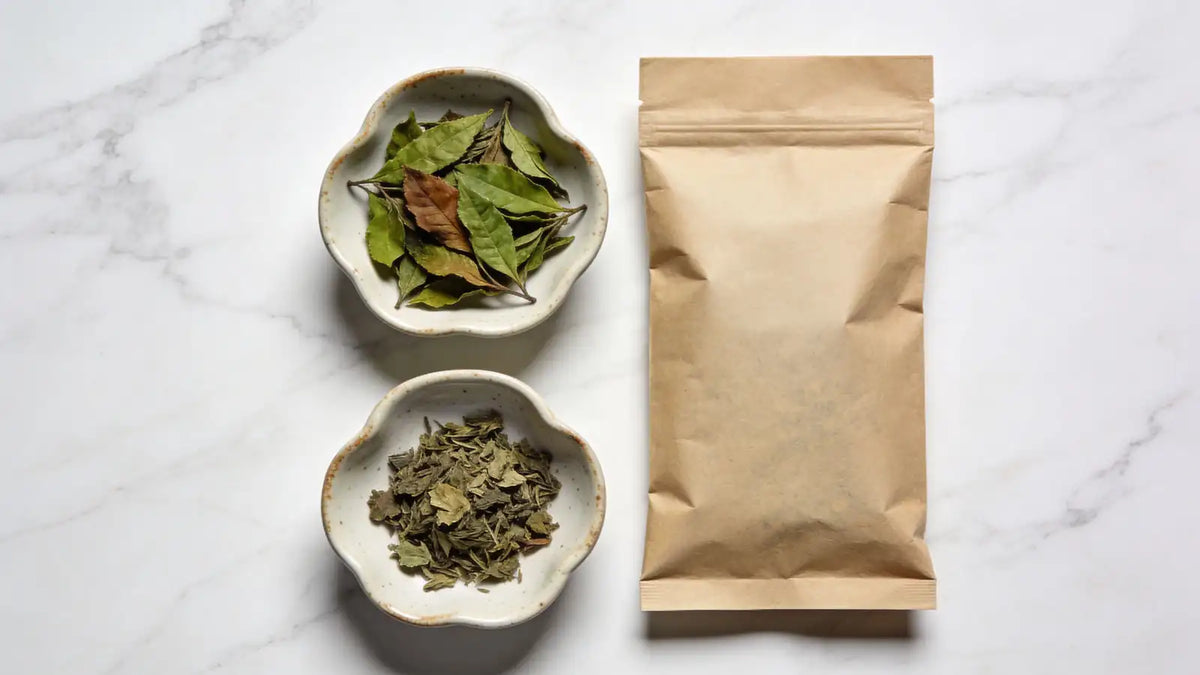
How to recognize properly dried leaves?
- The color must be green to green-brown, uniform, with no suspicious black or gray spots
- The leaves must be crunchy and snap cleanly when folded, not soft or pliable
- The aroma must be herbaceous, vegetal, slightly lemony, distinct and pleasant
- They must not no musty or damp odor
Natural air drying in a dry area, without direct exposure to intense sunlight, is the traditional method that best preserves the plant's properties.
Criterion 4: Packaging
Packaging is not just an aesthetic consideration: it plays an important functional role in preserving the leaves.
Good packaging must be:
- Hermetic : to prevent moisture from entering and preserve the aroma
- Opaque or light-protected : direct light degrades aromatic molecules
- Sturdy : to prevent the sheets from crumbling during shipping
Avoid non-resealable transparent bags and untreated cardboard boxes. Opt for airtight freshness pouches or glass jars with airtight lids.
Criterion 5: Size and integrity of the leaves
The size and condition of the leaves are direct indicators of harvest quality and the processing workflow.
Premium quality sheets are:
- Whole or minimally fragmented : Overly crumbly leaves indicate poorly managed transport or overly aggressive drying
- Standard size : neither too small (signs of premature picking) nor abnormally large
- Free of foreign matter : twigs, insects, various debris
A small amount of fine particles at the bottom of the pouch is normal. However, if a large proportion of the pouch is made up of powder and debris, the quality is questionable.
Criterion 6: Seller transparency
A reputable seller is a transparent seller. Here is the information they must be able to easily provide to you:
- The botanical name of the plant (Alchornea cordifolia)
- The country or region of origin
- Recommended storage conditions
- Usage instructions
If this information is missing or unclear, ask questions. A trustworthy seller will always be happy to provide clear answers.
🌱 How to compare multiple products before buying?
For buy djeka leaves rest assured, here is a quick reference guide:
| Criterion | Search for | Warning sign |
|---|---|---|
| Origin | Specific country cited | "Africa" wave |
| Aroma | Herbal, lemony | Neutral or moldy |
| Color | Green to green-brown | Yellow, black, gray |
| Texture | Crunchy | Soft, moist |
| Packaging | Sealable pouch | Transparent non-resealable |
| Price | Fair and consistent | Abnormally low |
Any unusually cheap product should always set off alarm bells. Traceability and optimal drying come with a cost. A very low price is often a sign that quality has been compromised somewhere along the supply chain.
🌱 Why choose Les Jardins d'Aïssa for your djeka leaves?
At Les Jardins d'Aïssa, our djeka leaves meet every one of the criteria listed above:
- Origin: Senegal : full traceability
- Natural drying : traditional, plant-friendly process
- Airtight, recyclable freshness pouch : optimal storage
- Premium whole leaves : rigorous selection at the source
- Full transparency : all available information listed on the product page
🌱 FAQ - Choosing the right djeka leaves
Does a higher price guarantee better quality? Not always, but a price consistent with the costs of organic production and rigorous traceability is a good sign. Be wary of abnormally low prices.
Are djeka leaves sold in pharmacies better? The purchase source (pharmacy, grocery store, online retailer) does not guarantee product quality. What matters is certification, origin, and drying process, not the distribution channel.
Can you smell the leaves through the pouch before buying? In a physical store, yes, it is actually an excellent test. Online, rely on detailed descriptions and customer reviews that mention the aroma.
How much should you buy to get started? A 50 g pouch is ideal for getting started. It lets you test different usage methods over several weeks without overstocking.
Do djeka leaves expire? Yes. When properly stored in a dry place protected from light, they retain their quality for 12 to 18 months. After this period, the aroma fades.
🌱 Conclusion
Choosing high-quality djeka leaves is not complicated when you know what to look for. Organic certification, known origin, optimal drying, proper packaging: these four criteria are enough to distinguish an exceptional product from an ordinary one. You can also discover our complete guide to djéka leaves.
You now know exactly what to look for. Stop leaving decisions up to chance. Discover our organic djeka leaves right away and treat yourself to an experience that lives up to the reputation of this ancient plant.

Discover why our customers love it

À lire aussi
Djeka leaves, wellness routine and usage precautions
Wellness routine with djeka leaves: the guide to adopting its daily uses Some plants deserve to be at...
Lire l'article
Origin and traditions of djeka: the journey of a sacred plant from West Africa
Djeka: origins, history, and traditions of a deeply African plant When we talk about djeka leaves, we are...
Lire l'article
How to use djeka leaves: complete step-by-step tutorial
🌱 How to use djeka leaves? The complete guide You've just received your firstdjeka leavesand you're wondering how...
Lire l'article
Leave a comment